When was the last time you rested without feeling that you had to earn it?
For many of us, even a quiet moment becomes yet another task: fall asleep, clear the mind, relax correctly. Yoga Nidra offers a different invitation. You can pause, listen, and notice what is present effortlessly — without having to make anything happen.
What is Yoga Nidra?
What if rest were more than closing your eyes? What if you could soften your body and still be present for what happens within it?
Yoga Nidra is often translated as “yogic sleep.” But nidra, ordinary sleep, and Yoga Nidra, a guided practice of awareness, are distinct. Sleep is a natural and necessary activity. In the Yoga Sutras (1.10), nidra is described as a vritti, an activity of the mind whose object is an experience of absence. We may wake without remembering any particular thought or dream and still know that we slept. Yogic philosophy often associates this settling and heaviness with tamas. This is a way of describing experience, not a medical label for depression or a measurement of slow-wave sleep.
Yoga Nidra invites us to explore what happens when the body rests and awareness is gently sustained. Swami Satyananda Saraswati calls it a state of “dynamic sleep” in his book Yoga Nidra: the person may appear to be sleeping, while consciousness functions at a deeper level. Kamini Desai, in Yoga Nidra: The Art of Transformational Sleep, emphasizes the art of non-doing — allowing the effort to manage every thought and sensation to ease. Both point to a practice with more depth than simply taking a nap.
An older yogic map names four states of consciousness: waking (jagrat), dreaming (svapna), deep dreamless sleep (sushupti), and turiya, “the fourth,” described as awareness beyond the first three. During a guided practice, you may notice the world around you, drift into images or wandering thoughts, encounter a quiet gap, and return to the sound of the teacher’s voice. The guidance invites you to move toward deeper rest while observing these shifts. In that sense, the four states offer a map for inquiry, not four boxes every participant must check in order. Turiya is a spiritual concept, not a sleep stage a teacher can verify in a class.
That distinction matters. Some people stay aware throughout; some drift off and wake again. Neither experience is a failure. Yoga Nidra gives us a way to practice resting with awareness, and it may support sleep, but it does not replace the biological need for regular sleep. There is room for both: the sleep your body requires and the conscious rest you can cultivate.
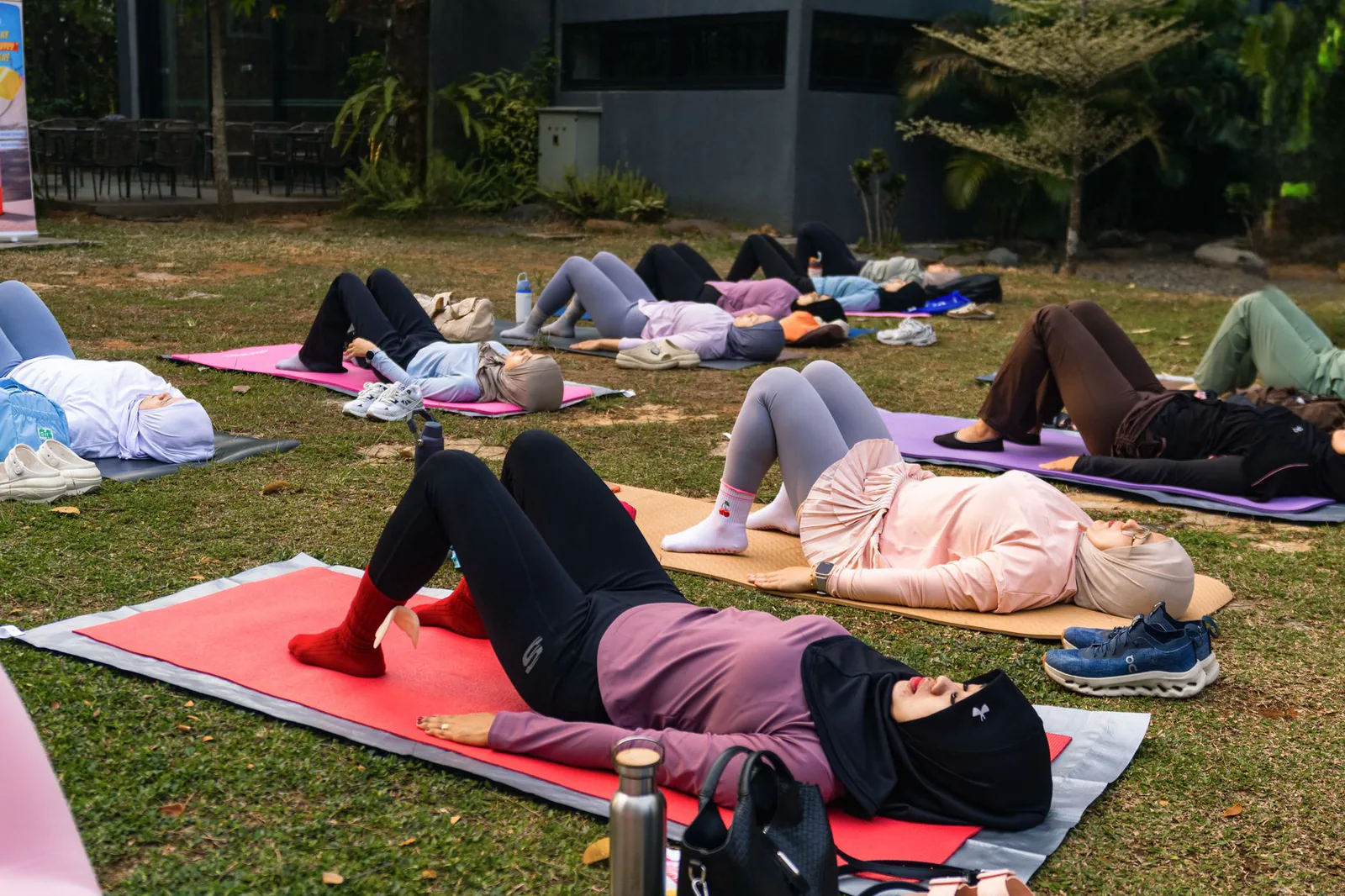
A practice unfolds in phases. We begin by settling in and turning attention inward. You may be invited to hold a simple intention, then follow a guided rotation of awareness through the body. From there, we notice the natural breath; explore sensations, feelings, or imagery without needing to change them; and repeat the intention before gradually returning our attention to the room. That is a broad six-part arc, rather than a rigid script — different teachers may separate or combine steps, and you always have a choice about what feels supportive. You can practice lying down, seated, or supported by pillows, blankets, or a chair. There are no poses to master and no need to stay perfectly still. You can begin by listening.
What does the research suggest?
Researchers are increasingly studying Yoga Nidra. In “Effects of Yoga Nidra on Stress, Anxiety, and Depression: A Systematic Review and Meta-Analysis,” Shashank Ghai and colleagues reviewed 73 studies involving 5,201 participants and found promising results for stress, anxiety, and depression. In “Efficacy of Yoga Nidra in Managing Sleep Disorders: A Systematic Review of Randomized Controlled Trials,” Abhijit Dutta and colleagues examined six randomized trials involving 244 participants; most reported improvements in time to fall asleep, total sleep time, and sleep efficiency.
Those findings are encouraging, but they need context. The practices, participants, and ways of measuring outcomes differed across studies. Many studies had methodological limitations. We cannot promise that Yoga Nidra will treat insomnia, anxiety, or depression, or that every person will experience the same result. It may, however, support deep rest, stress regulation, emotional well-being, and healthier sleep as part of a broader approach to care.
What might a first practice feel like?
You do not need to arrive calm. You might notice a busy mind, restlessness, comfort, or fatigue. There is no test at the end. If an instruction does not feel helpful, you can adjust your position, open your eyes, focus on the room, or simply listen. Rest can be approached with choice and curiosity.
That flexibility matters to me. At Get Even Yoga, I use movement, breathwork, mindfulness, meditation, and deep rest in ways that can be adapted to the person in front of me. Yoga Nidra can be especially welcome when effort and overwhelm have taken up too much space.
Begin where you are
You do not need to be flexible, experienced, or “good at yoga” to try Yoga Nidra. A guided practice designed to support deep rest, stress regulation, and healthier sleep can be a simple place to begin.
I guide Yoga Nidra on Sundays at 8:30 a.m. at Arise Yoga Movement in Kirkland. Save your spot at ariseyogamovement.com. For a more personal approach, ask about Yoga Nidra or book a consultation with Get Even Yoga.
Yoga Nidra can complement care, but it does not replace evaluation or treatment for persistent sleep or mental health concerns.